Southern Dharma Retreat Center

  • Facebook
  • Instagram
  • YouTube

  • About
    • Mission & Vision
    • Board of Directors
    • Staff
    • Practice Community
    • History
    • Justice, Diversity, Equity & Inclusion
    • Accessibility
    • Land
  • Retreats & Programs
    • Retreat Calendar
    • About Retreats
    • Planning Your Visit
    • Scholarships & Fellowships
    • Cancellation Policy
  • Live & Work
    • Working at Southern Dharma
    • Careers
    • Volunteering
    • Retreat Volunteers
    • Residency
  • Give & Receive
    • Generosity as a Practice
    • Scholarships & Fellowships
    • Ways to Give
    • Gift Certificates
    • Donate
  • Stay Connected
    • Blog
    • Maha Sangha
    • Programs in Asheville & Online
    • Latest Newsletter
  • Donate

A New Years Gratitude Practice

January 7, 2026 By Southern Dharma Staff

A1_04310
A1_04305
A1_04272
A1_04298
Cory HeadShot
midshot on the mountain
IMG_2025
RZ Headshot B&W (1)
be814ac6-ae5a-8f2c-d519-b8d5df503d32
Leslie pic
Jo Pic
Ashly pic

Since the final bell rang out

on our New Years retreat January 1, Southern Dharma staff have been slowly winterizing and shutting down the retreat center for the season. The pantry is being emptied, the floors scrubbed, the proverbial shutters drawn on the space until April when we can welcome you all back again.

New Years of 2025 was rung in just the same way, with yogis and teachers  alternately singing, chanting, and sitting in the meditation hall until midnight called them down to the dining hall for a sweet treat from the kitchen. But for staff and board, that fall and winter of 2024 did not feel neatly closed. Many in the region reflected that, after Hurricane Helene blew trees bare in September, time only felt like it was passing again when the leaves returned in spring.

That winter, following the disastrous hurricane and great administrative changes at Southern Dharma, it was clear that the challenges of 2024 were not yet finished. And that 2025 would call on the collective strength, effort, and authenticity of all its staff, board, and the innumerable others who support the center.

Now, a week into 2026, the Southern Dharma ecosystem is resilient and well-rooted for the years to come. And though, yes, the 2026 retreat schedule is now open for registration, and, yes, that is a very exciting, big deal—we want to take space here and now to practice gratitude. We want to say thank you to the many hands who made last year what it was, with all its perfect imperfections, and many practice opportunities that led to profound growth for the organization.

First, our teachers: Their guidance and practice are what bring people to Hap Mountain year after year. Every retreat, someone, often many someones, walk away with their life forever changed. Our teachers are our foundation and our blessing, and we want to offer them a deep bow of gratitude for their service in the world.

To our Board of Directors, whose care for Southern Dharma led them into service, thank you. When board members arrive for their meetings, there are smiles and the fluttering sound of a far-off flute by the stream. The expertise, knowledge, and kindness that each member holds is a gift to be in community with.

Thank you to our Retreat Managers who contributed to the Southern Dharma ecosystem in the midst of their “normal” lives, both near and far. With your presence, each retreat felt deftly held.

Gratitude to our dozens of Retreat Volunteers who, over the course of the year, have stoked countless fires, made a monstrous quantity of oatmeal, quietly helped our kitchen staff prepare daily meals, and generally made each retreat run seamlessly. You're the best.

Thank you also to Kris Moon and Keaton Hill who worked with focused intention and grace in supporting staff and connecting Southern Dharma further with the Western North Carolina community. Deep, deep bows to both of you and the work you continue to do in service to the community.

Before Cory's arrival as our Executive Director, staff and board were guided by our wonderful Interim Executive Director Rachel Zink, whose empathy, organization, and skillful communication helped us understand how we can move forward as an organization and nonprofit, grounded in the wisdom of where we are now.

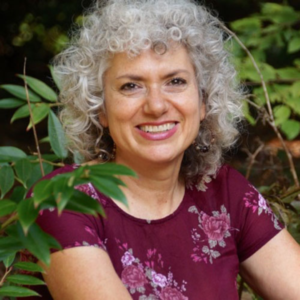
We are grateful for so much that our Executive Director Cory brings to the SDRC team, but especially her ability to take the work she does seriously without being serious about it! She lead with playfulness, steadfast clarity, encouragement, and optimism, and models both self-care and temperance to those she leads.

Keith Felicity, who has acted as our Interim Retreat Center Director and Programs Manager, has created a supportive and compassionate framework for Southern Dharma during times of great transition. As they move toward their Clinical Pastoral Education internship following their Master of Divinity degree, we will miss their dedication, authenticity, silliness, and compassionate presence in the retreat season to come.

The radiance, laughter, and smiles that Facilities Lead Lizeth brings to the center can hardly be missed in whatever space she moves through. We get to see her act with generosity, curiosity, and bravery every week and are consistently moved by her joyful, loving, and hospitable spirit. The work she's done in the last three years with Southern Dharma shines with care and focus.

Anyone who has come on retreat this year has tasted the skill, creativity, and heart of Josh, our Kitchen Manager. In addition to nourishing our bodies with his delicious food, Josh has nourished the people he works closely with through both silliness and care, his skills in communication and willingness to turn towards difficulty. Josh was supported in the kitchen in the latter half of the retreat season by Jo Watson, Ashly Lovell, and Leslie Hammond-Jones. We want to thank this team for all of the care you gave to the food, the land, the yogis and the staff!

Huxley is our facilities support who shows up, not only as a handyman-wizard, but also as a living invitation to slow down and reflect. Each dialogue with Huxley is an opportunity for engaged, intentional communication with collaboration and care. His knowledge and interest in the natural world, curiosity about those around him, and generous playfulness makes him a cherished member of our community.

And of course we could not function without Amber, our beloved bookkeeper, whose honesty, attention to detail, and heart-centered nature is seen in all the work she does.

Most of all, thank you to our yogis. Thank you for your practice, your willingness, and your commitment. Without your dedication to your spiritual path, Southern Dharma could never have grown to be what it is today, 47 years since its founding.


PS: Vanessa is great. Hands down. All of these words, except for this gratitude for her, have been crafted and organized and edited by her careful and capable hands. Vanessa has been our registrar and communicated with so many retreat participants. She has also cooked and managed retreats to boot. Vanessa has been helpful, kind, compassionate, and passionate in each of her roles in our community. You can even read a blog post she wrote about the history of Southern Dharma's land. She is a loving and creative spirit that touched many of us this year. (-Keith Felicity!)


Filed Under: Uncategorized

Q & A With Cory Adams: Meet Southern Dharma’s New Executive Director

November 3, 2025 By Southern Dharma Staff

by Vanessa Moss, SDRC Staff

Cory Adams joined Southern Dharma Retreat Center as Executive Director on October 1, 2026. Having lived in Asheville since 1997, Cory steps into her role at Southern Dharma with over eighteen years experience in strategic planning and organizational development. She joins us from OpenDoors of Asheville as their College & STEAM Director, working to close race-based opportunity and achievement gaps through education. Before OpenDoors, she led Asheville’s nonprofit Odyssey School as Executive Director for eight years, nearly doubling their student base and annual budget during her tenure.

Hear more about her background, inspirations, and skillsets in her conversation below with Vanessa Moss, SDRC's Communications Coordinator.

VM: What about Southern Dharma Retreat Center inspired you to apply for this position?

CA: My spiritual commitments lie at the heart of my life–they are the seed around which everything else is layered, so when I saw the ad for the position at Southern Dharma, I was curious to find out if this role might be a path toward aligning my work and my practice at a deeper level.

VM: During your first month as SDRC’s executive director, have there been any events or experiences that particularly stood out to you?

CA: It’s been a pretty busy few weeks just getting started at the Center. We’ve had the fall Board retreat, which was a great opportunity to meet almost all of the Board in person and start to build a plan for what comes next for the center. I’ve had some good time with staff as well, and that is nourishing too–it’s settling to see the day-to-day necessities of running Southern Dharma and the impact the staff make on our retreatants’ experiences. 

VM: You got to meet one of our founders, Elizabeth Kent, a few weeks ago at our Community Picnic. What was that experience like?

CA: I was very blessed to spend some time talking one-on-one with Elizabeth Kent at our community picnic, and she shared some powerful words about her intentions in creating Southern Dharma. One thing that she shared was the experience of being guided by a deep feeling for silent meditation. She did not know what she was doing or why she was doing it when she started meditating, but she kept showing up. And ultimately her commitment to that practice and process led her to create something that has endured for more than forty-five years–that is a powerful statement to the impact that one deeply committed human can make. 

VM: Share with us about your past work in nonprofits and how you think it translates to this new role at SDRC.

CA: I worked for many years as the Executive Director of Odyssey School, an independent school founded on Ken Wilber’s model of the evolution of human consciousness, and I developed into that job through working with the founder, John Johnson, who taught me a lot about slowing down, being more aware, and attending to the seed of truth that each community member brings forth into the shared field of awareness. 

One of the core focuses of our work at Odyssey was in developing meta-cognition in children through centering exercises–in essence, meditation. And we worked to support students in finding different kinds of tools to help them connect inward–to help them build a compass with which they could learn to explore the world around them. Southern Dharma is a space that is fully dedicated to the adult quest inward, and I love that about it. There’s something so grounded about asking people to take time out, turn toward themselves, inquire into their own illusions, crazy thoughts, emotions, and experience. To me, the most practical thing a human can do in this life is to orient to what is most important.

VM: Tell us a bit about your own personal practice. How did you find it, and what have you learned from it?

CA: As a follower of Meher Baba, I have meditated for many years in my own spiritual tradition. In raising two kids and running a school, and later doing equity work, that practice has been honed to be responsive to the needs of each day. I pray every morning, some rote prayers, some spontaneous. I do sun salutations to move my body. Most recently, I have incorporated walking as a daily practice–this helps me to get into my tissues at a cellular level and for me personally is part of the work I do to stay in touch with what is present in the moment.

VM: Why do you believe in the value of contemplative practice?

CA: As an administrator, I have learned–I was taught–to slow down, reflect, listen, and be with whatever is coming into awareness before responding. My mentor once told me that he believed that 98% of the issues that arise in an organizational framework can be responded to with this kind of process. 

On a deeper level, my experience is that contemplative practice works like cutting a path in the forest (wilds) of the mind and spirit. At its best, practice provides a way to build relationship with the ineffable. 

VM: How are JEDI (justice, equity, diversity and inclusion) principles core to SDRC’s work and mission? How do you hope to support this commitment as ED?

CA: Making Southern Dharma as accessible as possible is essential to the Center reaching its mission. It has been part of my lifelong work in different roles to become aware of barriers different populations and people face and to explore what can be done to eliminate those barriers. My last role was primarily working with Black communities in Asheville to find access to high quality education. That work taught me a lot about how important it is for children, and really all people, to see themselves represented among leadership at all levels–a lesson I carry forward to this new role.

VM: If SDRC was given $1 Million dollars, what would you do with it?

CA: If SDRC was given a million dollars, I would ensure the money was invested and saved so that the Board could begin the process of deciding a strategic vision for the new evolution of the organization’s growth over the next ten years. My primary goal is to shepherd the beauty, sanctity, and magic of Southern Dharma forward so that many generations of people can return to share this silence and practice together.

VM: What are some of your other passions in life, outside of your practice and nonprofit work?

CA: My family is a place of deep devotion for me. I am thankful for the teachers in my close family circle who have shown up to give me the hardest and best lessons. Past that, I am an award-winning self-published author of a debut fantasy novel–I grew up writing and reading fantasy, sci fi, and fell in love (pun intended) with romance as an adult. I love genre fiction for many reasons, including the way it encourages people from all backgrounds to write their own stories. I could talk a lot about why I think romance is one of the most subversive and necessary genres in fiction, especially in the current cultural landscape. Writing, for me, is another core joyful and disciplined practice.  


Filed Under: Uncategorized

Community Series: Palestine/Israel

September 2, 2024 By Southern Dharma Staff

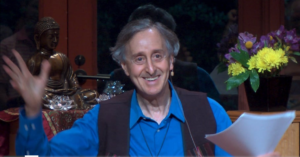
In July and August of 2024, Southern Dharma offered a series of three online programs, designed to support members of our sangha in responding to the crisis in Israel/Palestine with greater empathy, care, and grounding in our teachings and practices. We were led in our practice by Ronya Banks and Donald Rothberg, two senior teachers in our community.

Below you will find descriptions of our sessions along with recordings (video/audio as well as audio only) of the second and third sessions. The first session consisted of personal reflections from community members in small groups and was not recorded. You are welcome to share these resources as you see fit.

We are grateful for everyone that participated in these programs, especially our teachers and our hard working Southern Dharma staff. All of the sessions lasted 90 minutes and were freely offered.

Please free to to reach out to us at info@southerndharma.org if you would like further information about the series, or you may contact the teachers directly using the information provided below.

May all beings find peace.


Session 1: Listening & Sharing in Community

In this session, we had the opportunity to join together with other members of the Southern Dharma community to share and receive from the heart in relationship to our experiences related to what’s been happening in Israel/Palestine. The intention was for us all to have the opportunity to hear and be heard with kindness, empathy, and care – all of which can co-exist with disagreements. With the support of shared guidelines and shared practice, facilitators and participants co-created a listening and sharing space that honored both the diversity and the commonality of our experiences. Both small groups and large group listening and sharing opportunities were offered.

This session was not recorded.

Session 2: A Dialogue between Teachers and Friends

In session 2 of this series, Donald Rothberg and Ronya Banks engaged in dialogue around their Jewish and Palestinian identities, their family histories, and their own experiences of being Buddhist teachers navigating the complexities of the conflict in Palestine/Israel. During the course of the conversation, they offered reflections on what has been most helpful to each of them in dealing with painful truths, strong emotions, and difficult conversations.

Session 2 audio recording only (Dharma Seed)

Session 3: A Buddhist Toolkit for Skillful Response

In the final session of this series, teachers Ronya Banks and Donald Rothberg offered a number of resources that can help practitioners navigate these times through the cultivation of meditation, wisdom, and ethics.

How can we avoid reinforcing "either/or" mindsets and other binaries that create delusion and misunderstanding?

How can we draw on the teachings to strengthen our commitment to compassion for all in these difficult times?

And how can we identify and move toward skillful action, rather than being caught in a state of paralysis, frustration, and despair on the one hand, or acting out of reactivity on the other?

Together teachers and participants explored specific trauma-sensitive practices that are suitable for all practitioners.

Please note: Video recording begins 17 minutes into the start of the session. For the full content, feel free to listen to the audio only recording linked below.

Session 3 audio recording only (Dharma Seed)


About our teachers


Ronya Banks (she/her) is a Buddhist teacher of Palestinian heritage who is using her practice to process intergenerational trauma and respond to the challenges of this time while maintaining equanimity of all people affected by conflict.
Learn more about Ronya Banks.


Donald Rothberg (he/him), author of The Engaged Spiritual Life, is a longtime Southern Dharma teacher of Jewish ancestry who has taught in Israel, traveled several times to the West Bank, and supported efforts to approach the conflict based on Buddhist practice.
Learn more about Donald Rothberg.

Filed Under: Uncategorized

Sourdough Dharma Practice

May 1, 2024 By Southern Dharma Staff

by Nancy Wright, Board Chair

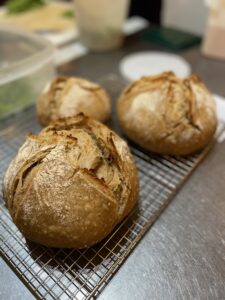
[Three baked loaves of sourdough bread on a stainless steel table. 05.14.2022]
The jar of gooey flour and water sat on my counter with an impish grin inked on the side in black marker. “Sammy,” I pleaded, “what do you need? Are you hungry? Thirsty? Too cold? Would you enjoy a different type of flour?” Sammy the Sourdough Starter just smiled. Despite its jaunty demeanor, Sammy’s effectiveness as a starter was very questionable. The last effort at using Sammy to make bread resulted in a loaf so dense it could be used as a weapon. But was Sammy to blame? Intensive internet research, conflicting instructions from two sourdough cookbooks, and impassioned conversations at grocery checkout lines revealed almost unlimited reasons for flops: over and under proofing, using a starter too soon or too late, over and under kneading, kitchen too hot or too cold. Sourdough is an enigma.

My husband and I embarked on our sourdough journey cheerfully collecting too many supplies and looking forward to hearty loaves of healthy bread. Over the next six months, sourdough would test my patience and my resolve again and again. One disappointing loaf followed another, punctuated by anxious research and endless conversations about causation. As I mixed yet another batch of dough, my husband helpfully remarked, “I hope it turns out!” I broke under the weight of expectations. “It’s not about that,” I snapped. “We can only hope that we learn something from the process.” Wait, what did I just say? Breaking through my grumpy mood, I realized that this was, in fact, a pearl of wisdom. Maybe I could let go of the outcome and be curious about the living organisms that were bubbling up in Sammy.

Here’s what I have learned (so far) from sourdough:

1. Cultivate Not-Knowing. When Roshi Bernie Glassman founded the Zen Peacemakers, he articulated Three Tenets. The first is Not-Knowing or “don’t know mind.” This isn’t an invitation to stupidity, but a recognition that when we think something can be “known” through and through, we shut down our curiosity and openness to new insight.

Sourdough made it easier to give up on “knowing” because even the so-called experts often disagreed. Still, it took me an embarrassing amount of time to realize that I could not fix my sourdough by research and force of will. Once I took my blinders off, I became more attentive to texture, smell, temperature, and changes over time. The tension in my shoulders eased and was replaced by a feeling of contentment as I fed Sammy, measured flour, stretched and folded the dough.

2. Slow down. Buddhism is brimming with rituals and teachings designed to slow us down so that we can really be present. Sitting meditation or zazen starts with a physical deceleration (“just sit!”) so that we can have some hope of recognizing our lightning quick reactivity. I’ve come to appreciate this on the cushion, but I will admit that it is not often that I am able to bring that level of presence to my non-cushion life.

Enter sourdough. In general, it takes days to make a single loaf of bread. The wild yeast in the starter cannot be manipulated and quickened like processed yeast in packets. My efforts to speed things along always backfired. And then there’s the “feeding” of the starter. While it is in the process of becoming active, it must be “fed” once (sometimes twice) a day. Over time, I looked forward to this quiet time in the morning, stirring and measuring, tending to the tiny bacteria and yeast cells, drawing another face on the jar to gauge the rise.

Little by little, I began to learn the joy of paying attention to the small things, tending to the task before me.

3. Share the joy. I am known to overshare, particularly if there’s potential for a good story. When I eagerly began the sourdough journey, my adult children were assaulted with a running account of Sammy’s activities, or lack thereof. My son eventually told me that he was starting to think of Sammy as a new sibling, but he would be deeply concerned if he discovered that I added Sammy to my will. This is not the type of sharing that I needed to learn.

In the Dhammapada, the Buddha is quoted as saying, “We are shaped by our thoughts; we become what we think. When the mind is pure, joy follows like a shadow that never leaves.” By trading a mind focused on outcome for a mind focused on the life in front of me, joy followed.

Even better, I was not spreading my irritation and “fix it” mentality to the poor beings around me. For a small portion of the day, the world was made a little less sad, annoyed, or judged when I turned my attention to thoughts of tending.

And all this patience and careful attending has, in fact, resulted in actual loaves of warm, crunchy, delicious sourdough bread. The joy just keeps spreading.

Nancy lives in Gainesville, Florida with her husband, Jim, and senior dog, Citta. She credits her Southern Dharma retreats as preventing her from burning out in her work as an attorney helping people with disabilities receive Medicaid services so that they can live at home. In March of 2023, Nancy received lay ordination (jukai) in the Soto Zen tradition through Upaya Zen Center. As Chair, she hopes to not get in the way of the living practice of the Dharma both on the mountain and off.

Filed Under: Uncategorized

Anicca in Appalachia

November 21, 2023 By Southern Dharma Staff

by Vanessa Moss, Resident

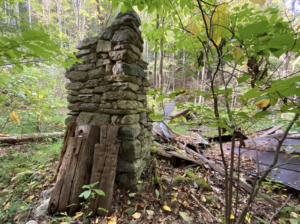
Crumbling stone chimney in the woods
[Grass grows around panels of tin roof and the homesite chimney, where someone rested a few of the notched corner beams. 10.08.2023]
On my first retreat at Southern Dharma, I was struck by the old homesite relics punctuating the landscape, using my lunch breaks to meditate near them. Now, I’ve lived at SDRC for six weeks as a resident, affording more time to connect with this land and its history.

I sat to meditate on a moss-covered rock and the final gusts of September blew up the valley, making the leaves quiver. The creek next to me cantered, pulling water down from the mountain into Wooleyshot Branch and then on to Spring Creek, eventually joining the French Broad River at its confluence in Hot Springs. For millions of years, water has lapped away at these Appalachian hills.

A walnut fell from above, crashing through branches before cracking like a gunshot on a thin sheet of tin. The old roof lay flat, hemmed in grass. Trees had fallen through the center of a once one-room cabin, scattering its roof and log walls. The only thing semi-intact was a half-crumbled stone chimney stack. I wondered if walnuts fell on the house when it was lived in; if the sound of them crashing on the roof woke its dwellers as they slept.

These people were neighbors to the Waldroups, if not Waldroups themselves. Perhaps this cabin was the farmhand quarters for the family, if they needed to hire people from town to help with tobacco harvest. This was the family that Elizabeth Kent and Melinda Guyol bought 135 acres from in 1978 to form the Southern Dharma Retreat Center. 

These farmers were far from the first in this region. There aren’t records of any permanent Native American communities in Spring Creek, specifically, but that doesn’t mean it wasn’t occupied. These hills could be hunted, and the more hospitable bottomlands of Spring Creek likely drew people to grow crops in small settlements. 

The Yuchi tribe or Tsoyahá, meaning Children of the Sun, lived in current-day Greene County, Tennessee, about ten miles from Southern Dharma. From 1500-1700, their population split and relocated, changing names and locations frequently, making their history hard to trace. By 1715, they were presumably driven out of the region by European settlement pressures and conflict with the Cherokee. Come the 1830 Indian Removal Act, they were forced from the state of Tennessee and became a distinct group within the Creek Nation of Oklahoma.

Meanwhile, the Cherokee or Aniyvwiya (the “Principal People”) lived mostly in towns to the southwest of Madison County, with the nearest known settlements in Cataloochee and near Lake Junaluska. Today, the Eastern Band of Cherokee Indians live in the Qualla Boundary of Cherokee, about an hour and a half drive from Southern Dharma.

Both of these tribes were present in this region. And there were many tribes that pre-date them. Twenty miles northwest of SDRC is Paint Rock, where 5,000 year-old pictographs are drawn onto a cliffface. It’s thought that Paint Rock and the nearby Hot Springs was an intersection of trade and diplomacy for tribes. Spring Creek would likely have been a thoroughfare, a route to this cultural site.

Sitting by the homesite, I heard the midday birdsong slow. A tufted titmouse flew from a post oak’s branches and lighted on the uneven rock of the chimney, rising stolidly from the fallen home. The lives here had sparked, rose, and unraveled, then, like smoke, were gone.

I don’t want to think about my own death, or the way cultural changes pushed this rural farming family to abandon their valley, or the mass death and extrication of the historic tribes of these mountains. But it is the nature of our practice to bear witness. It is, in fact, what drew me to practice in the first place. To sit within the discomfort of impermanence, to reckon with the reality that all we love will be lost.

The loss of Native American life and culture in this region points to impermanence, but also the Kleshas, the poisons that Buddha taught propels beings around the cycle of samsara. It was out of greed, hatred, and delusion, the U.S. government forced more than 70,000 Native Americans from the eastern United States. Of the 17,000 Cherokee bound for Oklahoma, around 4,000 died of cold, hunger, and disease during the journey.

This region is part of that gruesome history. As practitioners, we use the present moment to observe the chain of dependent origination and recognize the interdependence of all beings. And, as in the Boddhisattva vow, to dedicate our practice to the liberation of all beings.

As I sat, looking at the lone chimney, I imagined my own home, my own family, my own land grown over and forgotten. What traces do I want to leave of myself, 200 years from now? 

To plant more trees. To be more generous. To love as well as I can. To hold in compassion the mistakes of the people before me, and in compassion make changes for the future.

Anicca, impermanence, is foundational to the Buddha’s teachings. It was the Buddha’s first insight, spurring him to leave his life of palace-bound privilege and seek the path of enlightenment. It lends us a sense of urgency: “If I am, then I will one day not be.” And then we hope the urgency of our practice eventually guides us beyond the concept of “I am.”

The wind around me blew harder and a curtain of ochre leaves fell. A single maple leaf landed in a rusted-out washing bucket, another fingerprint of human existence on this land. There are many traces like this to be found. Arrowheads, if you’re lucky, but also faint overgrown carriage roads, an ancient scrap of barbed wire, a broken piece of porcelain. So many lives were lived here.

And there must have been joy. Perhaps, as the adage goes, a whole 10,000 joys–coupled, undoubtedly, by 10,000 sorrows. All of them rising and unfolding, right here in this valley. 

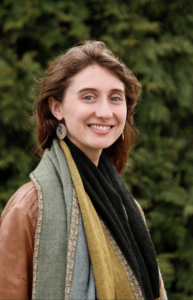
Headshot of Vanessa MossSouthern Dharma is a part of that unfolding, that experience of joy and sorrow. When we practice on this land, we must bear witness to the injustice and pain of its history. But we also have the opportunity to tap into the joys of this place, and the peace it inspires as a refuge for so many.

Vanessa Moss is a familiar face around Southern Dharma, as were her mother and grandfather before her. When she's not on retreat she keeps herself busy gardening and writing. You can read more of her work here.


Donate to the Yuchi Language Project, “to restore the vitality of the Yuchi language and create a sustainable language community where the fullness of the Yuchi worldview can thrive for future generations.”

Contribute to the Eastern Band of Cherokees Community Fund, “an unrestricted community grantmaking fund, to support local needs.”

Contribute to Madison County Community Fund, “an unrestricted community grantmaking fund, to support local needs.” 

Contribute to Southern Dharma Retreat Center.

Filed Under: Uncategorized

On The Path: An Interview With Linsi Deyo

March 22, 2022 By Southern Dharma Staff

This is part one of three of an interview Southern Dharma Executive Director Sonia Marcus conducted with long time friend of Southern Dharma, Linsi Deyo. Linsi is the owner of Carolina Morning, a company that specializes in meditation implements, cushions, seats, furniture and other supports. You can learn more about their work at www.zafu.net

SM: Let's start out, if you don't mind, by introducing ourselves. What I know about you so far is that Carolina Morning is your business and that you used to serve on the board at Southern Dharma. I was wondering if you could tell me a little bit more about yourself and your backgrounds.

LD: When I went to college, I was a philosophy major. And in the end, I was a philosophy major. I did a lot of switching, and I wanted to go to graduate school for Comparative Eastern and Western Philosophy. I got accepted at a school that I didn't want to go to, and I did not get accepted to the school I wanted to go to, so I decided not to go to the school I wasn't drawn to and ended up not really using my college education in the way I expected.

I was sort of trying to find myself. The closest I got to a career was my interest in therapy. I worked in mental hospitals, and I was on track to become a therapist. And inside of myself, I felt like I wasn't really ready to; I felt like I needed to heal more.

I had moved to Spring Creek—to Madison County—very close to Southern Dharma and had met Elizabeth and Melinda. I was very interested in Southern Dharma because I already considered myself a Buddhist and had done a number of retreats in the Northeast.

SM: How did you end up in Spring Creek?

LD: I hiked the Appalachian Trail.

SM: You just walked off the trail and into Spring Creek?

LD: Sort of. I hiked the whole trail. I started in Georgia and hiked all the way up to Maine with my boyfriend at that time and our dog, Otis.

SM: So it was the three of you on the AT.

LD: Yes. Otis couldn’t hike through the Smokies with us, so we boarded Otis. In the process of boarding the dog, we went through Spring Creek, and we met Pearl Goforth. Pearl lived very close to Southern Dharma, and for some reason, we stopped at Pearl's house. I think there was a dog in the road or something like that.

We pulled over. Pearl was an 80-year-old woman and we started talking to her—she was very friendly—and she said, “Dolly and Grace have that little house for sale up on the hill over there.” We looked up the hill, and she said, “If you think you like this area so much, why don't you just go ahead and buy that house?”

SM: Wow.

LD: Well we did.

SM: Talk about serendipity.

LD: I was very involved with the Tibetan Buddhist community [in Boston, where I came from]. There were very few Buddhists in Spring Creek at the time. Then, I found out about Elizabeth and Melinda and what they were doing. I'd only come to Buddhism in 1980, so I was in that ecstatic stage of having found this miraculous new way of life.

SM: What did that ecstatic stage look like? How did that manifest?

LD: This is what I consider the gem in my story related to Southern Dharma. I was very much enamored by the model of the Dharma teacher. Once I decided I wanted to be a therapist, I struggled for a long time with whether I wanted to be a Dharma teacher.

I was in my early and mid-thirties, so it's a time of life. I think we all do this in our own way. Really my lesson from Southern Dharma, by working so closely with Southern Dharma and getting to know the teachers, was realizing that the teachers were on the same path as me, and a lot of them had similar struggles to my struggles. That did draw me, and wanting to be part of bringing the Dharma to birth in that place was very exciting to me. The Dharma had, in combination with therapy, been a very powerful movement in my life and they still are. They still are.

Southern Dharma encouraged me to start Carolina Morning Designs, and Melinda and Elizabeth encouraged me to start it on my own.

SM: So it's not just that we have your cushions and zabutons here because you're a local company and you've been involved with Southern Dharma but because the whole company idea itself was born out of Southern Dharma and your experience with it.

LD: Absolutely. Elizabeth and Melinda were focused on diversity. This was the 80s and it wasn't that far away from the Women's Movement. As a kid in college, the Women's Movement was just starting at the end of the 60s and in the early 70s. Melinda, Elizabeth, and myself came out of the Women's Movement. It influenced us. As much as they wanted diversity, they wanted to empower women.

--

Keep an eye out for Part 2 coming soon!

Filed Under: Uncategorized

  • 1
  • 2
  • 3
  • 4
  • Next Page »

Stay Connected

Blog
Maha Sangha
Latest Newsletter
Careers

Follow Your Heart

info@southerndharma.org
1661 West Road
Hot Springs, NC 28743
828-933-3021

  • Facebook
  • Instagram
  • YouTube

Copyright © 2026 Southern Dharma Retreat Center